Why 4000K Always Looks “Off” in Tunable White LED Luminaires


From smart desk lamps to circadian-rhythm lighting systems, photography lighting and film lighting, tunable white LEDs have gone mainstream. The idea is simple: pack a warm-white LED and a cool-white LED into the same fixture, then vary their brightness ratio to sweep through the color temperature range—typically from 2700K all the way up to 6500K.
Sounds like a clean solution. But anyone who has actually measured these fixtures knows there’s a nagging problem: at the endpoints—2700K and 6500K—things look fine. Mix them to 4000K, though, and key metrics like DUV, Ra, and R9 take an unexplained nosedive. What’s going on?
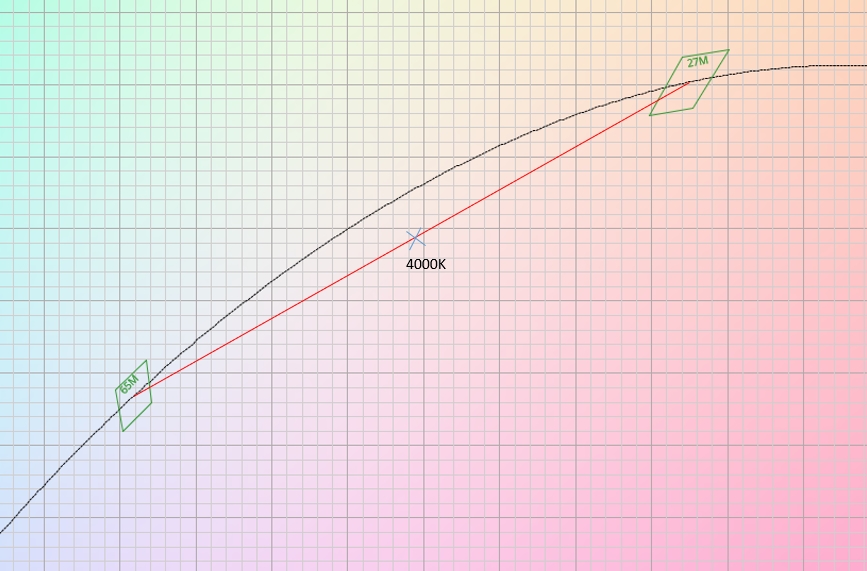
Key takeaway: On a CIE chromaticity diagram, the mixed color of two white LEDs traces a straight line between their two color points. But “pure” white should follow a curve called the Planckian locus. A straight line and a curve don’t overlap—which means mid-range CCTs inevitably drift off course.
Let’s start with the chromaticity diagram—the CIE 1931 standard, to be precise. Plot a 2700K (warm-white) LED and a 6500K (cool-white) LED on it, and you’ll get two dots: one in the reddish-yellow zone, the other in the bluish-white zone. The fundamental rule of additive color mixing says that any blend of the two will fall somewhere on the straight line connecting them.
The problem is that “pure” white light doesn’t live on that line. The human eye—and most industry standards—define white light by its proximity to the Planckian locus, the curving path traced by light from an idealized blackbody radiator as its temperature rises. This curve is the gold standard for correlated color temperature (CCT), which is why CCT values always reference it.
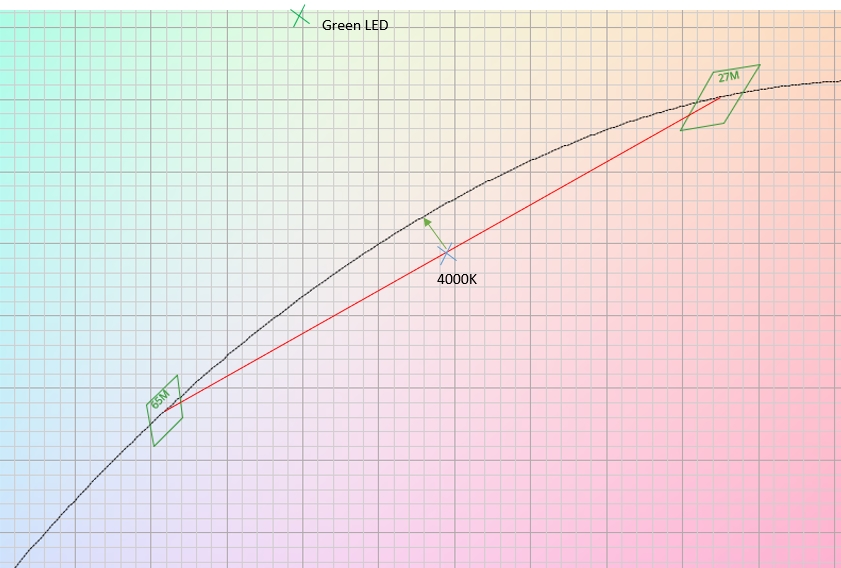
Look at Fig. 1. The two LEDs are labeled 27M and 65M. Their mixing line is nearly straight, while the Planckian locus gently arcs above it. At 4000K—roughly the midpoint—the mixed color sits conspicuously below the locus. That vertical gap is DUV (distance from the Planckian locus). Positive DUV means the light leans magenta; negative DUV means it leans green. Neither is desirable.
DUV quantifies exactly how far a light source has strayed from the Planckian locus. In a bi-color mixing scheme, the mid-range CCTs almost always show the largest DUV values. Depending on where exactly the two endpoint LEDs are placed on the diagram, the 4000K blend might come out greenish or purplish—not the “clean white” users expect.
And it’s not just the hue that suffers. Ra (the general color rendering index) and R9 (deep-red rendering) also degrade when the color point drifts off the locus. That’s because the spectral power distribution gets skewed: certain wavelengths become over- or under-represented, messing with how accurately objects reflect their true colors. You can have a 2700K and a 6500K LED that individually score well on Ra and R9, but their 4000K blend will almost certainly score worse on both.
Common observation: Good Ra/R9 at the endpoints, noticeably worse at 4000K, along with a bigger DUV. This isn’t a fluke—it’s a structural limitation of conventional bi-color mixing.
If the problem is that the mixing line doesn’t follow the Planckian locus, one obvious fix is to reposition the endpoints so the line does a better job tracking the curve. For example, you could nudge the 2700K LED slightly above the locus and the 6500K LED slightly below it. The new connecting line will hug the curve more closely, and the DUV at intermediate CCTs will shrink.
What makes this approach attractive:
The downsides, though, are hard to ignore:
The second approach is to leave the white LEDs alone and throw a third color into the mix: a dedicated green LED. On the chromaticity diagram, green sits above the Planckian locus—exactly where the mixed 4000K point needs to be pulled. With the right amount of green, you can “lift” the blended color back onto the locus.
Why you’d consider this route:
The trade-offs are not trivial:
Approach A: Shift White Points |
Approach B: Add a Green Channel |
|
✓ Pros
✗ Cons
|
✓ Pros
✗ Cons
|
The right choice depends on what you’re building. If your product targets applications where color quality around 4000K is critical—think premium desk lamps, museum lighting, or medical examination lights—the green-channel approach gives you the precision you need. If you’re looking for a cost-effective upgrade that mostly fixes the “off-white” problem at intermediate CCTs, and you can live with slightly compromised endpoints, shifting the white LED bins is the pragmatic shortcut.
Tunable white lighting looks straightforward on paper, but the geometry of the chromaticity diagram has the final say. A straight mixing line and a curved locus simply don’t align, and that gap is why 4000K so often looks “off.” Understanding how DUV, Ra, and R9 shift with the mixing ratio is the first step toward designing a fixture that delivers great light at every setting—not just at the extremes.
There’s no universal winner. The best solution is the one that strikes the right balance between color quality, product complexity, and cost for your particular target market.
Copyright © 2026 Beijing Yuji International Co., Ltd.